Showing posts with label accounting. Show all posts

Monday, December 31, 2018

Accounting Reports

Background

We've talked about how to record transactions, so now let's talk about reporting the summation of those transactions.

Question
Describe the following reports: Balance Sheet, Income Statement, Statement of Equity, Statement of Cash Flows
Answer
Balance Sheet reports on the current financial position.
Income Statement reports on the income and expenses that happened over a given period of time.
Statement of Equity reports on the changes in the reported worth of the financial entity.
Statement of Cash Flows reports on the changes in the cash balance over a period of time (this is usually only used for entities that use accrual accounting). 
Analysis

When the owners of a business receive reports on how that business is doing, there are a few things they'd like to know and the following reports cover those areas.

One thing a business owner would like to know is the financial position of the business. What does it own? What does it owe? That is the role of the Balance Sheet, also known as the Statement of Financial Position.

Another thing a business owner would like to know is the operational result of the business. How much did it earn? What did it cost to make that income? Did the business make a profit - if so how much? Or did it lose money? If so, how much? And why? That is the role of the Income Statement.

These two statements are the basic two. However, there are two others that are oftentimes used to give more supplementary information:

The first of these two is the Statement of Owner's Equity. This report is used to show the change in the value of the business. This report is more helpful with businesses that have more complicated ownership structures, such as with a corporation.

The other of these is the Statement of Cash Flows. This report is used to show the changes in the amount of cash a business has at the end of a period. The reason this report is often used is that cash is by far the most asset any business can have. While there are many different things a business can own, only one, cash, can be used to pay for things. If a business runs out of money, it's in trouble, and so keeping track of cash is vital.

Vocabulary used:

For more information check out these links (comment to add your favourite link):

Where might you have come from?

Fact-orials Index

Accounting Principles:
Where might we go?

Financial Reports:

Thursday, December 20, 2018

Cash vs Accrual Accounting

Background

We now know how to record transactions. The next question is when to record them...

Question
On Feb 1, a plumber goes to a customer's business to clear a clogged drain. The customer asks for a bill to be mailed. On Feb 2, the bill is mailed to the customer. On Feb 3, the bill arrives at the customer's business. On Feb 4, the customer mails a check. On Feb 5, the plumber receives the check. 
For the plumber and the customer, walk through when transactions are recorded. Do two timelines for each - one for cash accounting and one for accrual accounting.
Answer
Plumber, cash method:
Feb 5, DR Cash, CR Income 
Plumber, accrual method: 
Feb 1, DR Accounts Receivable, CR Income
Feb 5, DR Cash, CR Accounts Receivable
Business, cash method:
Feb 4, DR Expense, CR Cash
Business, accrual method: 
Feb 1, DR Expense, CR Accounts Payable
Feb 4, DR Accounts Payable, CR Cash 
Analysis

Before we get into how to record transactions under different types of accounting schemes, let's talk about the two basic types and why we might use each.

Cash accounting is the easier to understand of the two systems. Essentially, you record income transactions when you receive money and you record expense transactions when you pay money. Because the system is based on the receipt and payment of cash, knowing when to record transactions is simple and straightforward.

So let's track the accounting of our question for the plumber on the cash method:

On Feb 1, the plumber does work but isn't paid. No transaction is recorded. In fact, all of that stuff with the bill being sent out has no effect on the plumber. We're waiting for the receipt of cash.

On Feb 5, when the plumber receives the check from the customer, he has now received money and so records a transaction:

DR Cash
CR Income

(DR is short for Debit and CR is short for Credit)

Now let's do the same for the business on the cash method:

On Feb 1, the business has work done but doesn't pay for it that day. Since money hasn't left the business yet, no transaction is recorded. In fact, it's only when a check is sent to the plumber that an entry is made:

Feb 4
DR Expense
CR Cash

Now let's talk about Accrual accounting. Essentially, you record income transactions when income is earned and you record expenses when they are incurred.

How does this play out for the plumber and the business? Let's watch the plumber first:

On Feb 1, the plumber does work. He has earned income. It doesn't matter that he hasn't received cash yet - he records income. We'll also record that he is owed money:

DR Accounts Receivable (i.e. he is owed money)
CR Income

On Feb 5 when he receives the check in the mail, he has now been paid. We reduce the account that says he is owed money and increase the account that says he has money:

DR Cash
CR Accounts Receivable

And now let's do the business:

On Feb 1, the business called in the plumber. An expense has been incurred which will eventually need to be paid. We record the expense and we also record that money is owed to the plumber:

DR Expense
CR Accounts Payable (i.e. the business owes money to someone)

On Feb 4, the business sends payment to the plumber. The debt is paid and cash is decreased:

DR Accounts Payable
CR Cash

*****

So let's now talk about why we might use the accrual method vs the cash method of accounting.

Clearly, using the accrual method requires more work - it took twice as many entries to record the transactions under the accrual method than under the cash method. So whatever reasons there are to use accrual accounting, it has to be worth the extra work.

One reason the accrual method is preferred is that it follows something called the Revenue Recognition principle - which is what we described above when the plumber recorded income when it was earned and not when the bill was paid.

For accountants, it's important that income transactions properly follow when income is earned. The payment of cash isn't always a good indicator of when income is earned. For instance, what if the plumber had had to wait 3 months for payment? It wouldn't be fair or right for the plumber to not record the income until he got paid.

Another reason is that the accrual method also follows something called the Matching Principle - which means that expenses are recorded only when they can be properly matched to the income they were incurred to produce.

A prime example of this, which we'll discuss in a later entry, is depreciation. Depreciation is the recognition of wear and tear on machinery and other expensive assets in order to make income. For instance, let's say a business that will make widgets is getting started. The company has a large factory built. Should the company be able to record the building of the factory as an expense all at once? Or should it be reduced in value over time as the wear and tear of making widgets decreases its value? The Matching Principle says it should happen over time.

*****

One more note before closing this entry - the use of accounting method is independent of other businesses. The plumber could easily be using the cash method while the business is using accrual, and vice versa (the plumber could be using accrual accounting and the business using cash accounting).

Vocabulary used:

For more information check out these links (comment to add your favourite link):

Where might you have come from?

Fact-orials Index

Accounting Principles:
Where might we go?

Accounting Principles:

Tuesday, December 18, 2018

Recording Transactions

Background

We've covered the fact that with financial transactions, two accounts (at least) are impacted. So what types of accounts are there?

Question
What types of accounts are there? Name an example for each. Are the balances in each of them normally debits or credits?
Answer
  1. Assets are things we own and are normally debits. Cash is an example.
  2. Liabilities are things we owe and are normally credits. Accounts Payable is an example. 
  3. Equity is the net value of the business and is normally a credit. Owner's Equity is an example.
  4. Income is cash and other consideration we receive in the course of business and is normally a credit. Sales is an example.
  5. Expense is what is paid out in cash and other consideration in order to make income and is normally a debit. Salaries is an example. 
Analysis

We've discussed in prior entries about a merchant selling a cow for gold (i.e. cash). Let's talk about some transactions that are a normal part of business and examine the types of accounts that are impacted.

So let's start with that cow we keep talking about. We own it - it's ours. We call something like that an asset. Assets are things we own.

Along with the cow, things we own include cash (gold, silver, money, etc), land, buildings, inventory, and more.

Assets are normally debit balances - and so debits will increase assets and credits will decrease them.

Let's make a little story out of this. Let's say the only thing in the world we own is the cow and we're walking to the market town to sell milk.

Ok - we get to town late. We need to get a room for the night but the innkeeper only wants cash. We say we'll pay him when we sell milk tomorrow. The innkeeper agrees, and so we now owe the innkeeper money. That is a liability. Liabilities are things we owe, such as loans and debts.

Liabilities are normally credit balances - and so credits will increase liabilities and debits will decrease them.

Along with the debt to the innkeeper, we might also owe money to the tax collector, to a landlord, or to others.

At the same time, we now also record an Expense - money or value that we pay in order to make income. Other types of expenses include salaries, utilities, taxes, and more.

Expenses are normally debit balances - and so debits will increase expenses and credits will decrease them.

So let's now talk about what we're worth. Before going to town, we were worth one cow (for ease, let's say the cow is worth $100). And let's also say that we have to pay $1 per night at the inn. So after one night in the inn, we're now worth $99. Our equity is what we own less what we owe. Equity is Assets less Liabilities.

Equity accounts are normally credit balances - and so credits will increase liabilities and debits will decrease them.

We find a butter maker and we sell some milk to them. We get some money (let's say $2) so that is an increase in cash and so a debit. We also record Income. Income is money that we earn.

Income is normally a credit balance - and so credits increase income and debits decrease them.

Vocabulary used:

For more information check out these links (comment to add your favourite link):

Where might you have come from?

Fact-orials Index

Accounting Principles
Where might we go?

Accounting Principles:
Saturday, December 15, 2018

Double Entry Accounting

Background

While it's fine to count what you have, what happens when you start transacting business with other businesses? How do you keep tract of business activity? The answer is Double Entry Accounting...

Question
What is double entry accounting? How does it help business activity?
Answer
Double entry accounting is the process of recording two entries per transaction. This process helps to ensure accuracy with the records and helps to record both the results of where the business is at any given time and how it got there.
Analysis

Before there were formal accounting guidelines and rules, business people would keep records, perhaps haphazardly, to track business performance. For instance, if a merchant received money from selling a cow, the amount of cash they had would increase and the number of cows would decrease. This is simple and straightforward.

Merchants in Venetia (now a part of Italy) developed a way of recording transactions that would track current status and also business performance. Luca Paciolo wrote about this method in 1494 and in doing so became known as the Father of Accounting.

So how does this work?

If in our example above a merchant sells a cow and receives cash, that is an increase in Cash (a debit) and a decrease in Cow (a credit). There are two entries - one to Cash and one to Cow - so there is a double entry for each transaction.

Luca also talked about the need for recording all transactions in a central repository, which is called the General Journal, and the transcribing of appropriate transactions into their individual journals (so the Cash transaction would be recorded in the Cash journal, the Cow transaction would be recorded in the Cow journal, and so on). A quick way to make sure there have been no errors is to make sure that the debits and credits equal each other, both in the general journal and in summing the balances of each individual journal.

Vocabulary used:

Debit - an entry on the left side of a T account
Credit - an entry on the right side of a T account
T account - a quick and easy way to track activity in any given account

For more information check out these links (comment to add your favourite link):

https://en.wikipedia.org/wiki/Luca_Pacioli
https://en.wikipedia.org/wiki/Accounting

Where might you have come from?

Fact-orials Index

The Start of Accounting

Where might we go?

Accounting Principles

Thursday, December 6, 2018

The Start of Accounting

Background

With the creation of counting numbers, people had an easy way to keep track of different numbers of things. For instance, they could count what they owned...

Question
Why did accounting start? What's the purpose of it?
Answer
Accounting started right around the time numbers were created. The purpose of accounting is to organize financial transaction data.
Analysis

With the development of counting numbers, people could start to keep track of the numbers of things that they owned
. But more importantly, they could keep track of historic transactions. How many calves were born last year as compared to the year before? How much did I get per head of cattle from this trader versus that merchant.

This then is the primary purpose of accounting - to keep track of financial transactions and also to track financial position. This kind of information enables the users of it to make better financial decisions. For instance, is it better to trade a dairy cow for 10 egg laying hens or to decline the trade? Knowing the value of the milk coming from the cow as compared to the value of the eggs from the hens would be a great thing to know - and it's accounting that keeps track of this kind of information.

Because we don't want to destroy information in accounting, we don't subtract. Instead we try to only add information. 

For instance, let's say we're tracking the number of cows and chickens we have. We'll start with 10 cows and 0 chickens.

Cows = 10
Chickens = 0

Along comes that trader we talked about before and we decide that 1 cow for 10 chickens is a good trade. If we were to simply track the numbers of things we have, we might say this:

Cows = 9
Chickens = 10

which is true but it doesn't tell us how we got here. It'd better to have the ability to show the different transactions. Perhaps this way:

Cows:

Starting Number = 10
Given to Trader = 1
Ending Number = 9

Chickens:

Starting Number = 0
Received from Trader = 10
Ending Number = 10

In accounting-speak, the tracking of each individual thing is done within an "account". In the above example, we have two accounts: cows, and chickens.

We keep track of the transactions of each account in a "journal" for each account (there is also something called the General Journal - transactions are initially reported there, then transferred to the individual journals). 

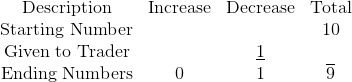
To help better keep clear transactions that increase and those that decrease an account, there'll be more space along the journal to show the transaction type. For instance, for the Cow account, it might look like this:


As we get more and more into the making of accounts and the different types, there are going to be a couple of things that make keeping track of information even easier.

The first is that, to make tracking transactions easier, accountants use something called a T Account - which is simply a T shaped way to track transactions. The Cow account would look like this:

               Cow
          ________
Start: 10   |
                 |   1 Given to Trader
                 |
         ____|_____
End:    9

(to show the end of a period of time where we sum up the results, we put the lower horizontal bar across. While it's open, that lower bar is left off and so it looks like a T and not a capital I.)

The other thing we'll do is not refer to things "increasing" and "decreasing" because sometimes one side of the T account will increase an account and sometimes it's the other side that will do it. Therefore, accountants refer to the left side of the T account as the Debit side and the right side as the Credit side.

Vocabulary used:

For more information check out these links (comment to add your favourite link):

Where might you have come from?

Fact-orials Index

The Start of Everything - the Fact-orials Table of Contents

Numbers:
Where might we go?

Accounting Principals