Showing posts with label integers. Show all posts

Wednesday, December 19, 2018

Exponentials and Integers - Practice Problems

Background

Let's work some more problems involving exponentials and integers. Keep in mind that even though we are inputting integers, we'll usually end up with fractions, i.e. rational numbers.

Question
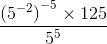
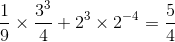
Evaluate:
  1.  
  2.  
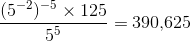
Answer
  1.  
Analysis

Since we're working specifically with exponentials, I'll do the work in terms of exponentials. Keep in mind that we could also get to the same answers by using fractional operations.

Question 1

Let's first put the terms into exponential forms:


And now we can do some exponential operations:


And now let's do the fractional operations:


Therefore:


Question 2


Let's once again put this into terms of exponentials:


And so therefore:


Vocabulary used:

For more information check out these links (comment to add your favourite link):

Where might you have come from?

Fact-orials Index

Operations with different kinds of numbers:
Where might we go?

Operations with different kinds of numbers:
  • Exponentials and Rational Numbers - Practice Problems

Sunday, December 16, 2018

Exponentials and Integers

Background

We know how to handle exponentials with whole numbers but what happens if we put in integers?

Question
Evaluate:
  1.  
  2.  
  3.  
  4.  
Answer
  1.  
  2.  
  3.  
Analysis

Let's work through a question we know before diving into what we don't know:

Question 1

We know that the base is 3 and the exponential is 2, which gives:


Question 2

We know that the base is -3 and the exponential is 2, which gives:


Question 3

Here we have a negative number in the exponential position. What does that mean?

When we have a negative exponential, we put the base into the denominator with the positive exponential. With our current question, that looks like this:


Question 4

We work this the same way as we did above:


General Rule:


Vocabulary used:
  • base - in an exponential term, the number that is being multiplied
  • exponential - in an exponential term, the number that says the number of times to multiply the base
For more information check out these links (comment to add your favourite link):

Where might you have come from?

Fact-orials Index

Numbers:
Operations:
Operations with different kinds of numbers:
Where might we go?

Operations with different kinds of numbers:

Wednesday, October 24, 2018

Multiplication, Division, and Integers - Practice Problems

Background

Let's do some practice problems!

Question
Evaluate the following:
  1.   
  2.   
Answer
  1.  
Analysis

For all of these questions, we start with the Order of Operations.

Question 1

Notice for this question that we have two sets of division that are being multiplied together. Let's do each division first (we can do that because those divisions act, in a way, like brackets). So let's simplify the numbers in those fractions first:


Now let's evaluate the divisions:


And lastly we can do the multiplication:


Question 2

We have some brackets to do first, so let's do them:


Now scan across what we have and see that the remaining brackets don't hold operations in them - they are there to clarify that the numbers inside them are negative. Ok - so what else is there. I see two multiplication signs and we do those first before doing addition and subtraction:


And now we work the addition and subtraction from left to right:


Vocabulary used:

For more information check out these links (comment to add your favourite link):

Where might you have come from?

Fact-orials Index

Operations with different kinds of numbers:
Where might we go?

Operations with different kinds of numbers:

Tuesday, October 23, 2018

Multiplication, Division, and Integers

Background

We've covered how to add and subtract negative numbers. How do we multiply and divide them?

Question
Evaluate the following:
  • 8 x 4; (-8) x 4; 8 x (-4); (-8) x (-4) 
Answer
  • 8 x 4 = 32; (-8) x 4 = -32; 8 x (-4) = -32; (-8) x (-4) = 32
  •  
  •  
Analysis

This topic is all about the number -1. While we worked with what happens when we subtract something bigger than what we started with (such as 3 - 5 = -2), multiplying and dividing by negative numbers boils down to dealing with -1.

Ok - so let's talk about -1. The multiplication rules that we're introducing in this entry are the following:

(-1) x 1 = -1
(-1) x (-1) = 1

Or in other words, if we multiply a negative number with a positive number, we'll get a negative number. If we multiply a negative number with another negative number, we'll get a positive number.

Let's now work a few multiplication problems.

We've already seen from the multiplication table that 8 x 4 = 32. So what happens when we start adding negative signs to the numbers?

(-8) x 4

Keep in mind that -8 = -1 x 8. So let's rewrite the question:

(-8) x 4 = (-1) x 8 x 4

We already know that 8 x 4 = 32. So let's rewrite again:

(-1) x 8 x 4 = (-1) x 32

And now following our rule in green that any positive number multiplied by a negative number results in a negative number, we can finish up:

(-1) x 32 = -32

So (-8) x 4 = -32

We can use the exact same process to find 8 x (-4) = -32

Now let's do the last one:

(-8) x (-4)

And rewrite the numbers:

[(-1) x 8] x [(-1) x 4]

We can rearrange the numbers using the commutative property:

(-1) x (-1) x 8 x 4

Again, we know what 8 x 4 is:

(-1) x (-1) x 32

So now we have (-1) x (-1). From our rules above, we know that (-1) x (-1) = 1. So let's rewrite:

1 x 32

And lastly we know that this is simply 32.

With division, it follows the same pattern. If one of the numbers we're using in our division is negative, the quotient will be negative. If neither are negative or both are negative, we get a positive.

So with , we use regular division and get 2.

With , one of the numbers is negative, so we get -2.

And with , both are negative and so we get 2.

And now we can do one last set involving both sets of rules at once.

What if we have a negative sitting in front of the fraction? Like this:


This is the same thing as having -1 multiplying the fraction:


We know what 8 divided by 4 is and we also know what happens when we multiply something by -1:


In like fashion, we can work out the other questions:


A trick people use to help keep track of the negative sign is if you end up with one in the top or bottom numbers of the division, so instead stick it out front - it doesn't change the value of the number at all. So we can do this:


and this


Vocabulary used:

For more information check out these links (comment to add your favourite link):

Where might you have come from?

Fact-orials Index

Numbers:
Operations:


Operations with different kinds of numbers:
Associated Operations:
Where might we go?

Operations with different kinds of numbers: