Showing posts with label rational. Show all posts

Tuesday, December 4, 2018

Addition, Subtraction, and Rational Numbers - Practice Problems

Background

Let's work some problems involving addition of rational numbers!

Question
Evaluate the following:
  1.  
  2.  
Answer
Analysis

Question 1

The first thing we need to do is get common denominators
. I'll do that by first doing prime factorizations of the denominators:

6 = 2 x 3
3 = 3
10 = 2 x 5

Now we look at each prime number and grab the biggest group of each.

There's a single 2, a single 3, and a single 5, which means the lowest common denominator is:

2 x 3 x 5 = 30

Now let's get our fractions set up so we can do the math:


Now we want our answer in "lowest terms" - which means we're going to look if we can take out any forms of 1 that are lurking in that fraction. And there are:


Therefore:


Question 2

Let's put all of the term into improper fraction terms.

We have these terms to work with:


The first term is already in fraction form so we're set here.

For the second term, we multiply the whole number by the denominator, then add that to the numerator, like this:


For the third term, we go through the process of converting a repeating decimal to a fraction:


We've split out the 8 from the repeating decimal, so now we can focus on that decimal:


Therefore:


We combine the whole number with the fraction:


Ok - we can now rewrite our original question:


Now we need a common denominator. I'll do the prime factorizations of the denominators:

7 = 7
2 = 2
9 = 3 x 3

Ok - we need a single 2, two 3's, and a 7. That gives:

7 x 2 x 3 x 3 = 126

Let's get our fractions set up for the addition:


Let's work through to see if we need to reduce this fraction.

We know that 126 has prime factors 2, 3, and 7. If 1613 is divisible by any of these, then we'll have an opportunity to do some reducing.

Is 1613 divisible by 2? No - it's not even.
Is 1613 divisible by 3? No - the sum of its digits does not sum to a number divisible by 3.
Is 1613 divisible by 7? No - this one we can try on a calculator or we could work it through using the divisibility facts.

Therefore, the fraction can't be reduced and we can keep the answer as .

So what is this number in mixed number form and as a decimal?

As a decimal, it works out to be 12.8015873016

As a mixed number, it works out to be 

Therefore:


Vocabulary used:

For more information check out these links (comment to add your favourite link):

Where might you have come from?

Fact-orials Index

Operations with different kinds of numbers:
Relations:
Where might we go?

Monday, December 3, 2018

Multiplication, Division, and Rational Numbers - Practice Problems

Background
Let's work some practice problems!
Question
Evaluate:
  1.  
  2.  
  3. 2.54 x 3.10986 x 175 
Answer

  1.  
  2. 2.54 x 3.10986 x 175 = 1382.33277

Analysis

Question 1

Let's see that we can rewrite the division part of the expression and turn it into a multiplication by using the inverted form of what we're dividing by:


And now we can combine the fractions:


And now we can see that we have exactly the same in the numerator and denominator, so the whole thing reduces to 1. Therefore:


It's in situations like this where we can "cancel" out terms in the numerators and denominators because they end up being a form of the number 1. Let's look at the statement again:


See the 3 in the numerator and that other 3 in the denominator? We can cancel them - we know that when we multiply the fractions together, we'll end up with 3 divided by 3, which is 1:


We cross out the 3s because with them dividing each other, they are now both 1.

And we can do the same thing with the 5s and 7s:


With all of the numerators and denominators being equal to 1, the whole thing is equal to 1.

Question 2

Let's once again notice that we have multiplication and division operations. We can convert the division operations to multiplication by taking the inverse of the fraction we are dividing by. We end up doing this:


Is there anything we can cancel? Yes - remember that 4 = 2 x 2 and that 6 = 2 x 3, so we can rewrite this way:


Now let's cancel 2s where we can:


That leaves:


Since 3, 5, and 7 are all prime, we can't do any more cancellations - we just do the multiplication and end up with the result of:


Therefore:


Question 3

I put this last question in less to work out the math (it'd be a long calculation but certainly do-able), and more to make the point that with calculators everywhere now, all we have to do is type the calculation into the machine and have it spit out the number:

2.54 x 3.10986 x 175 = 1382.33277

Vocabulary used:

For more information check out these links (comment to add your favourite link):

Where might you have come from?

Fact-orials Index

Operations with different kinds of numbers:
Relations:
Where might we go?

Operations with different kinds of numbers:

Thursday, November 29, 2018

Addition, Subtraction, and Rational Numbers

Background

We now know how to make rational numbers. Let's learn how to add and subtract them:

Question
Evaluate:
  1.   
  2.  
  3. 0.25 + 0.5 
Answer
  1.  
  2. 0.25 + 0.5 = 0.75 
Analysis

Question 1

When we're looking at adding and subtracting fractions, we can think of the operation in a couple of different ways.

One way is to think of the number line. The denominator, the 2, tells us the number of jumps we need to make to get from 0 to 1. If we're making the same number of jumps in our two fractions, then we can add up the number of jumps we've made (that's the numerator). So we can say:


Another way to view this is to think of a pizza. We take a pizza and cut it into the number of pieces in the denominator (i.e. 2). The numerator tells us the number of slices we have. And so if I have 1 out of 2 slices of pizza (that's the first fraction) and I add to it another slice of the same size, I now have an entire pizza to myself!


Question 2

When we're looking at two fractions with different denominators, we have to first make the denominators equal. Why? Well... we can answer that a couple of ways.

If we're thinking of the denominator as the size of a jump from on a number line from 0 to 1, if we're going to add the jumps together, we need to have the jumps be the same size!

If we're thinking of the denominator as the size of a piece of pizza, the two different denominators means we had two different sizes of pizza slices. We can't simply say we ate two pieces of pizza, because one was bigger and one was smaller.

When we're adding fractions, we want to add up the numerators and to do that we need the denominators to be the same. And we can do that by multiplying by clever forms of the number 1.

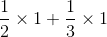
With our current problem, we have:


We have denominators of 2 and 3 and we'd like them to be equal. We'll find a common denominator (sometimes abbreviated as CD) and ideally the lowest common denominator (LCD). Which can get a bit confusing because this is the same as the lowest common multiple (LCM) of the denominators.

For 2 and 3, we can pretty easily see that the LCD is 6. However, let's run through a prime factorization to see it:

2 = 2 x 1
3 = 3 x 1

For the LCD, we look at each prime number and grab the biggest group of each one. For our question, there is a single 2 and a single 3. We multiply them together to get 6. So we want our denominators to each be 6. We get there by multiplying with clever forms of 1:


and so


Question 3

When we add decimals, we can put the numbers one under the next and line up the decimals (we can fill in any spots needed with 0s). In our case, we have:

0.50
0.25

and now we add down:

0.50
0.25
0.75

Vocabulary used:

For more information check out these links (comment to add your favourite link):

Where might you have come from?

Fact-orials Index

Numbers:
Operations:
Operations with different kinds of numbers:
Associated Operations:
Where might we go?

Operations with different kinds of numbers:
Relations: